
According to sources in the Bengaluru-headquartered space agency, under the Department of Space, delivery of hardware by the industry was hit due to the lockdown imposed in several States to contain the pandemic in recent months.

In a boost for the country's surveillance capabilities to monitor activities of both military warships and merchant shipping in the Indian Ocean Region (IOR), the 'Sindhu Netra' satellite developed by a team of young scientists from Defence Research and Development Organisation (DRDO) was successfully deployed in space on Sunday.

Skyroot Aerospace has become the first private company in India to give wings to the Indian space programme, after the sector was opened to private players by the Centre in 2020.

'Sixty percent IITians are in India, many heading great institutions in the private and public sectors,' says Professor M G K Menon.

This image features the left image within the red channel, and the right image within the blue and green channels, resulting in a striking cyan hue.
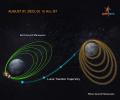
The ISRO had said it would attempt softlanding on the lunar surface on August 23.

"Indeed, a satisfying feeling," K Radhakrishnan who as the then Chairman of Indian Space Research Oranisation (ISRO) led the Mars Orbiter Mission (Mangalyaan) team said on achieving the milestone.

Indian Space Research Organisation (ISRO) will conduct three more test vehicle missions under the ambitious Gaganyaan programme after the maiden TV-D1 test flight, which is scheduled on October 21, the space agency's chairman S Somanath has said.

The images show VELC (Visible Emission Line Coronagraph) and SUIT (Solar Ultraviolet Imager) instruments as seen by the camera on-board Aditya-L1 on September 4, 2023.

The smartest homes are not the ones that dazzle with tech, but the ones that disappear into your daily life while quietly elevating it.
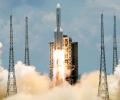
India's first privately developed rocket -- Vikram-S -- is set for launch in a sub-orbital mission with three payloads between November 12 and 16, Hyderabad-based space startup Skyroot Aerospace announced on Tuesday.

The Indian Space Research Organisation (ISRO) successfully launched its third and final developmental flight of Small Satellite Launch Vehicle here on Friday whose payloads can be used in applications like satellite-based surveillance, disaster and environmental monitoring, fire detection, volcanic activity among others.

A single-stage liquid propulsion rocket, equipped with a Crew Module and Crew Escape System, is slated for a lift-off from the first launch pad at the spaceport here at 8 am on Saturday.

On Friday, July 14, India launched its ambitious third lunar mission Chandrayaan 3, eyeing a rare feat in moon exploration.
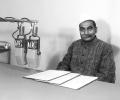
'The largest listenership for Vividh Bharati outside the country is in Spain.' 'The labourers who go there for the tomato-picking season feel cut off from their country and listen to Vividh Bharati to overcome their loneliness.'

For the first time in the history of Indian space research, a satellite developed by a university in India will be launched by the Indian Space Research Institute (Isro) during the next flight of the Polar Satellite Launch Vehicle (PSLV). Tentatively scheduled for launch in March-April this year, the vehicle will carry a small remote-sensing satellite completely developed and fabricated by Chennai-based Anna University, sources in Isro said.

Film folk like Akshay Kumar, Chiranjeevi, Jr NTR and Sunny Deol congratulated the country and the Indian Space Research Organisation (ISRO) on the historic achievement of Chandrayaan-3's landing on the Moon.
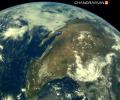
The pictures were captured by L 14 camera on board Chandrayaan II. The pictures show the earth in different hues.

ISRO chairman S Somanath said the success gave the space agency "greater confidence," as the GSLV will be next deployed in the NISAR mission, a collaborative effort with the US' NASA.
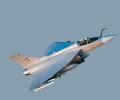
'An HAL-private sector tieup is a possibility.'

The United Nations General Assembly, heeding to a call by Prime Minister Modi, had made a declaration in December 2014 to observe June 21 every year as IDY.

Modi and the Crown Prince will co-chair the second meeting of the Strategic Partnership Council, established during the prime minister's 2019 visit to strengthen bilateral ties.

Chandrayaan-3's success is a must for India's space ambitions; we can't afford to lose out. And for realising our space dreams, the Indian private sector must be encouraged because if we lose this race, the moon, Mars, and mineral-rich asteroids will already be crowded before we reach there.

India's biggest telecom players, Bharti Airtel and Reliance Industries-backed Jio Platforms, will soon bring billionaire Elon Musk-led SpaceX's Starlink satellite services to India. According to analysts, the move could boost India's tele density, especially in the rural areas, and may be an opportunity for investors to add the two stocks on dips for long-term gains

Even as concerns grow over the residential real estate market reaching its peak, the outlook for office real estate remains strong, with listed real estate investment trusts (Reits) standing to benefit from sustained demand in the segment.

According to the space agency, Chandra's Surface Thermophysical Experiment measured the temperature profile of the lunar topsoil around the south pole, to understand the thermal behaviour of the Moon's surface.

Alur Seelin Kiran Kumar was on Monday appointed as the new Indian Space Research Organisation chief. Kumar succeeds K Radhakrishnan, who retired on December 31, 2014, as the eighth chief of the prestigious space dispensation.

A jubilant Nair was addressing a press conference at the ISRO headquarters in Bangalore on Friday after a NASA payload aboard the Chandrayaan-1 found Hydroxyl, a molecule consisting one oxygen atom and one hydrogen atom, in the lunar soil.

The company is targeting countries like Germany, Italy, France, Spain, Portugal, and the UK which account for over 70 per cent of Europe's two-wheeler volumes.

Shifting the focus to its next space odyssey after successfully placing a lander on the moon's uncharted South Pole region, the Indian Space Research Organisation (ISRO) chief S Somanath on Saturday said that the country's maiden solar mission Aditya-L1 is ready and will be launched in the first week of September.

The Indian Space Research Organisation (ISRO) will perform the final manoeuvre on Saturday to inject Aditya-L1 spacecraft -- the first space-based Indian observatory to study the Sun -- into its final destination orbit, some 1.5 million kilometres from the Earth.
For all the jokes that have been going around for decades that when American astronaut Neil Armstrong set foot on the moon, an Indian was already there, seriously, the hype about an Indian on the moon may be still be a ways off, according to the Chairman of the Indian Space Research Organization G Madhavan Nair.

Some of the suggested strategies include making thoughtful trade-offs between career choices and family responsibilities to avoid the guilt of not spending adequate time with elders and children at home; resisting the pressure to be a 'superwoman' by trying to manage everything alone; demanding, negotiating, and selecting jobs with flexible working hours; exploring work-from-home options; choosing an appropriate time for a career break; upskilling to re-enter the workforce after a break; and communicating openly with family members -- including spouse and in-laws -- about the support needed to grow professionally and the challenges faced at work, highlights N Ravichandran.

Aditya-L1 is meant to observe the corona, which are the outer layers of the Sun, extending to thousands of kilometres.

Heralding a new era, India on Friday night launched its heaviest commercial space mission ever with its polar rocket successfully putting five British satellites into the intended orbit after a flawless takeoff.

AzaadiSAT had around 75 small payloads developed by schoolgirls of 75 rural schools.

'Arundhati Roy is like a ballerina performing on a high wire, cool, supremely at ease but conscious of all the adoring eyes on her,' notes P Vijaya Kumar.

Launched on September 23, 2009 using the Polar Satellite Launch Vehicle from Sriharikota, Oceansat-2; is designed to provide service continuity for operational users of the Ocean Colour Monitor (OCM) instrument on Oceansat-1. The agreement with the Indian Space Research Organisation will lead to the use of data from Oceansat-2 for various US agencies for research, education and other activities of public good, including weather forecasting.

Its duties include experiments to further understand the lunar surface.
